
The other day I was at a friends housewarming party and we really craved some good latte and cappuccinos. Since they just moved in, they did not have their espresso machine unpacked yet and we decided to make lattes at home.
Do you want to show your barista skills by making the perfect homemade latte, cappuccino or flat white – even without using any fancy espresso machine? Read on and I will show you the secret to making the perfect latte. If there’s in the world of coffee a drink that is both extremely known and extremely confusing, that’d be the latte. The source of the confusion starts from the name.
So to kick things off we will start by grinding our beans.
No coffee.
Yet in the common parlance of coffee drinkers, a latte has come to be much more than the actual meaning of the word. The origin of the name comes from the Italian “caffé e latte”, which simply means coffee and milk. And that’s closer to what is intended when ordering “a latte” in a cafe today.
A latte is one of the most beloved and widespread coffee drinks worldwide thanks to its nearly perfect recipe. It consists of ⅓ coffee, ⅔ hot milk, and a thin layer of milk foam. The overall size is in the range of 10-12 ounces. Not extremely large as to be heavy nor too small as to finish too soon.
Just about perfect.
History of the Latte
The name is Italian but the origin of the drink isn’t. The history of latte goes back to around the 1600s when coffee was getting known in most of Europe and North America.
Many didn’t stomach a black coffee. Milk was found to nicely pad the harsher flavors of coffee. Nobody knows who first added milk to their black coffee, but in 1867 William Dean Howells wrote an essay titled “Italian Journeys”.
In the essay, it was clear that many Europeans had been drinking coffee with milk for breakfast for generations.
The birth of the latte or “caffé latte” is thus old and uncertain.
Whereas old drinks like the “café au lait” or “kapuziner” or “milchkaffee” were diffused in Europe since decades, it’s only after the Americans started drinking it that the word “latte” was commercially used to indicate a mix of coffee and hot milk, also in Europe.
Latte was simply a shorthand for “caffé latte”. It was easier to pronounce and write.
How does it compare?
An easy name for a very confusing drink. Many similar coffee beverages exist today that resemble a latte but have slightly different ingredients and doses.
It is highly possible to order a “latte” in countries all over the world and be presented with as many different drinks as the bars you’re ordering it in.
To make it clearer for you and avoid looks of confusion when receiving your cup, let’s see what are the differences between a latte and 3 of its close cousins.
The café au lait is French in origin. It predates the modern use of the word latte and is drunk in every part of the world where the french had at least some influence. That’s not the only difference, though.
It differs from a latte in the amount of coffee used and its brewing method. A latte is an espresso-based drink, the coffee is brewed with an espresso machine, while a café au lait is a filter-based drink.
Sometimes a french press is used to make a café au lait. The ratio of coffee to milk is higher in a café au lait than in a latte: nearly 50/50%.
Of course, variations are aplenty so don’t be surprised to be served a café au lait with the same ratio of coffee than in a latte. In some bars, the café au lait has little or even no milk foam.
Popular in Italy is instead a “latte macchiato”. Don’t take this for a “macchiato”, in which over an espresso a splash of hot milk is added.
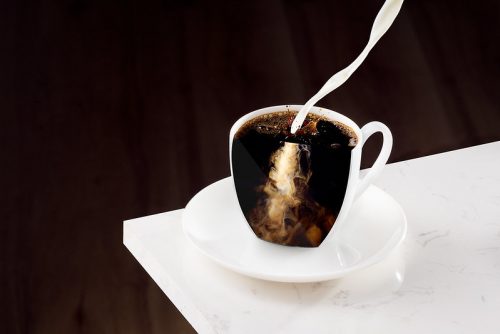
In a latte macchiato, a cup of steamed milk is added. Then half a shot of espresso on top, making a white drink with a small black stain caused by pouring the espresso.
“Macchiato” means stained in Italian after all.
The difference between a latte macchiato and a latte are thus in the quantity of coffee. h
Half the amount in a latte macchiato, and the order in which the ingredients are merged. In a latte, the espresso goes first and then the steamed milk. The opposite is for a latte macchiato.
Subtle differences but they make a lot of impact on the final taste. A latte macchiato is much less intense than a latte.
Stronger than a latte is instead the cappuccino. The correct recipe calls for ⅓ coffee, ⅓ steamed milk, and ⅓ milk foam.
The foam in the cappuccino is frothed firmer than for a latte, making a thicker layer on top. As the ratio of milk to coffee is equal, the taste of coffee is stronger in a cappuccino than in a latte.
The foam has a stronger feeling, while in a latte is more velvety and smooth. The cappuccino is also often a smaller drink than a latte, usually about 6-8 ounces instead of 10-12.
Due to reduced size and different proportions of the ingredients, the cappuccino is more caffeinated than the latte.
How to Make a Latte
Enough about other drinks. Its time to make the perfect homemade latte without using any fancy machines. We know the ratio of coffee, milk, and foam in a latte but not how to actually make a proper latte at home?
You don’t need to be a trained barista to manage to. You only need to have some patience and a few ingredients and equipment:
- A simple french press
- A milk frother
- A milk pitcher
- A coffee grinder (if you grind the coffee yourself)
- 7-9 ounces of milk
- About 16.5 grams of ground espresso beans
- A cup capable to contain 10-12 ounces of liquid
The preparation is straightforward. Pull a shot of espresso in the cup.
Steam and froth the milk in the pitcher, taking care to not let it foam too much as it needs to stay on the liquid side. Pour the milk over the espresso, not pouring the froth until the glass is nearly filled (about 1 inch/2.5 cm from the rim).
Then add the froth to finish your latte. Serve it straight or with sugar, as per your taste.
What can you add?
One of the best features of a latte is that it is flexible. Given that the coffee component of it is not large, substituting it with an alternative is possible and won’t sound blasphemous to many baristas.
A latte tea is a reality and delicious, for instance. Simply remove the espresso and use an equal amount of tea of your choice and proceed as above.
It can’t get any easier!
What about the hot summer months? You can make an iced latte!
The recipe is identical to the hot latte but with the difference. You should froth the milk much earlier and let it cool down to room temperature.
Then add enough ice cubes in a cup to make both the espresso and milk quickly cold and pour the coffee and milk in the same way as in a normal latte. Your iced latte will be ready in no time!
Serve and enjoy!
Variations to the classic latte abound. Sugar is commonly added to sweeten it, as topping with cocoa powder, coconut shavings, or any syrup of your liking.
The options to make a latte truly yours are nearly infinite. It wouldn’t have had such a long history if it wasn’t a super-flexible drink after all.
Conclusion
The powerful fascination of a latte lies in its simplicity and the perfect marriage of coffee and milk. It is lighter on the palate than a cappuccino but strong enough to get your dose of caffeine.
It has a smooth consistency and has a huge number of optional ingredients that don’t go in contrast with the basic coffee and milk ratio but enhance it.
So now go experiment and enjoy your lattes!
If you want the best coffee delivered straight to your door every month, click here to get a Lifeboost coffee subscription!